




- Home
- >
- DEVELOP ITS PEDAGOGICAL PRACTICES
- >
- Continuous development of practices
- >
- 1ʳᵉ Université d’Été de l’Andragogie – Apprentissage des adultes dans...
At the initiative of Daniel Evans, pedagogical referent and director of programs for Executive Education at Audencia, the first Summer University of Andragogy was held in Nantes.
This day brought together more than twenty training professionals (teachers, facilitators, training managers and HR professionals) around a common objective: to explore the most relevant practices for designing and delivering training courses for adults in companies.
Thought as a space for exchange and sharing of practices, this first edition alternated interventions, workshops and discussions around the current challenges of continuing education: posture of the trainer, facilitation, educational technologies and integration of artificial intelligence.
In this context, the Learning & Teaching Development team at Audencia conducted a workshop dedicated to the use of technology and AI in adult education.
The role of Learning & Teaching Development Team
Le pôle Learning & Teaching Development accompagne les équipes pédagogiques d’Audencia dans la conception de dispositifs d’apprentissage innovants et efficaces.
Ses missions couvrent notamment :
-
the design pédagogique de cours et d’ateliers,
-
l’accompagnement des enseignants dans leurs pratiques,
-
the développement d’activités pédagogiques,
-
l’intégration d’outils numériques et de technologies éducatives,
-
la diffusion et le partage de pratiques pédagogiques au sein de la communauté académique.
In a context where educational technologies and generative AI open up new possibilities, it seemed essential to us to propose a workshop rooted in the practice, directly mobilisable by the participants.
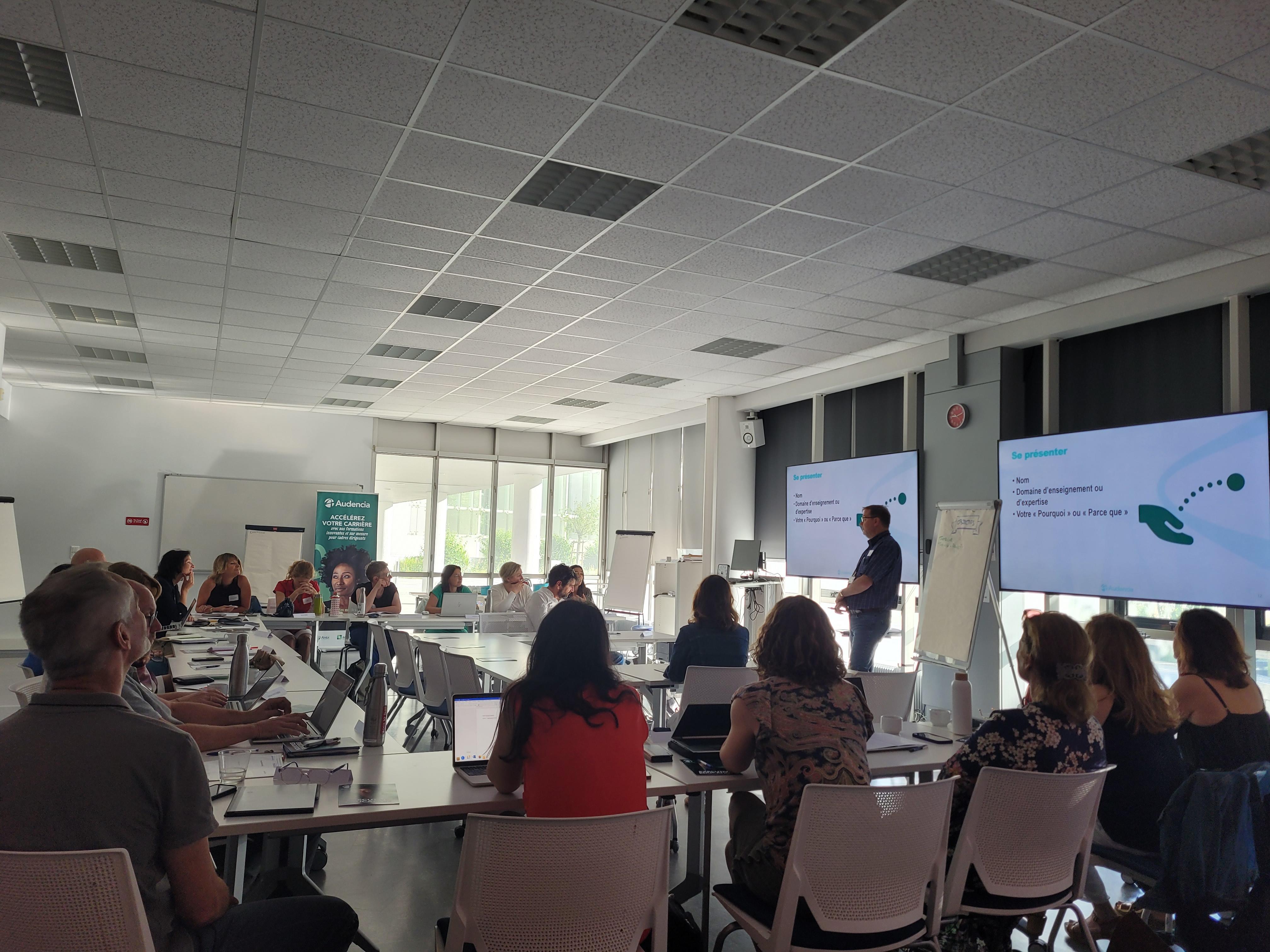
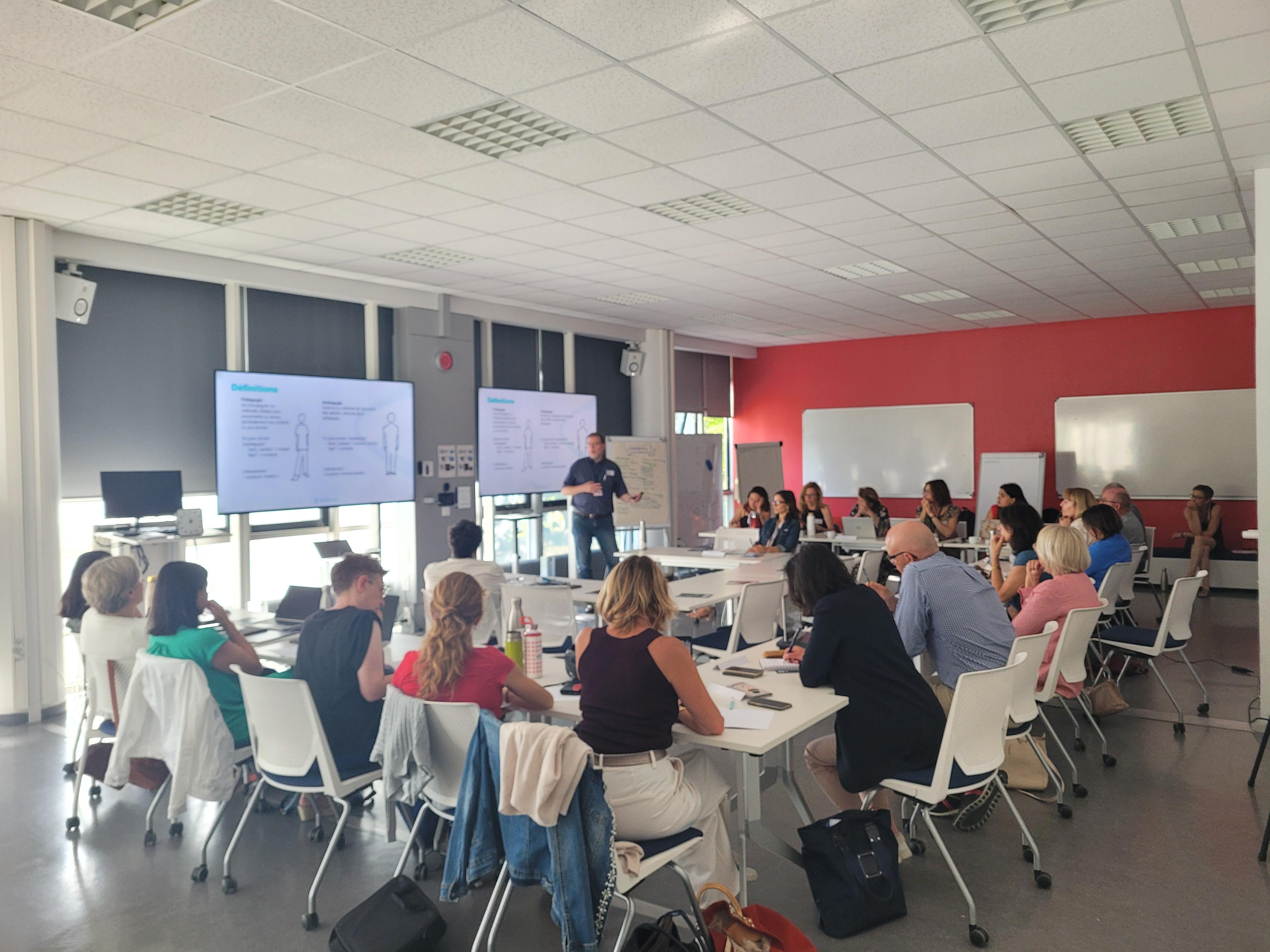
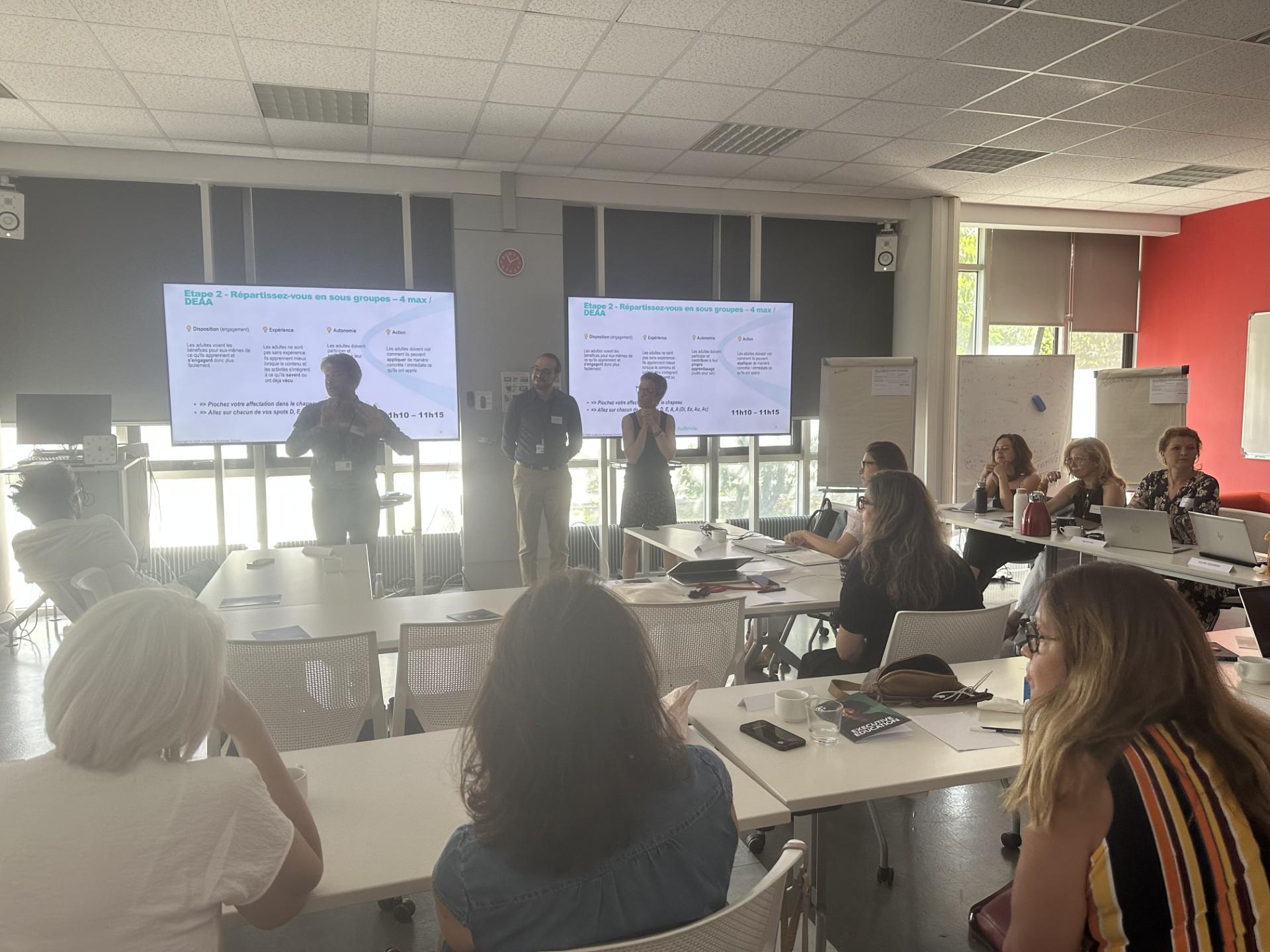
A workshop focused on practice: technology, AI and andragogy
Our workshop, entitled “The use of technology and AI in adult education – practical tips and solutions”, aimed to explore how these tools can enrich pedagogical practices, without losing sight of the fundamental principles of andragogy.
To structure the reflection, we relied on the model DEAA :
-
Disposal : prepare and motivate the adult learner.
-
Experience : value the experience and existing knowledge.
-
Autonomy : promote self-directed learning.
-
Action : allow a concrete and immediate application.
The objective was to allow the participants to identify concrete educational activities integrating technologies and AI, in different contexts: training design, in-person animation and distance learning.


A collaborative format: Think – Pair – Share
In order to promote collective intelligence and the sharing of experiences, the workshop was designed in the form of an activity Think-Pair-Share.
1. Feedback from experience
We started with a quick tour de table: each participant had 30 seconds to share a memorable experience related to the use of technology or AI in training.
These feedback were recorded on post-it notes in order to constitute a first mapping of uses and perceptions.
2. Work in sub-groups
The participants were then divided into sub-groups, each associated with a component of the model DEAA.
Each group had to think about educational activities mobilizing technologies and AI in three contexts: before the formation (design), during the in-person training, in distance learning.
3. Design of activities
During this phase of work, the groups imagined different educational activities, based on their practices and the tools they already use.
AI could also be mobilized to generate ideas or structure activities.
4. Collective restitution
Each group then presented its proposals during a three-minute pitch, allowing to share the ideas with all the participants and to spark new discussions.
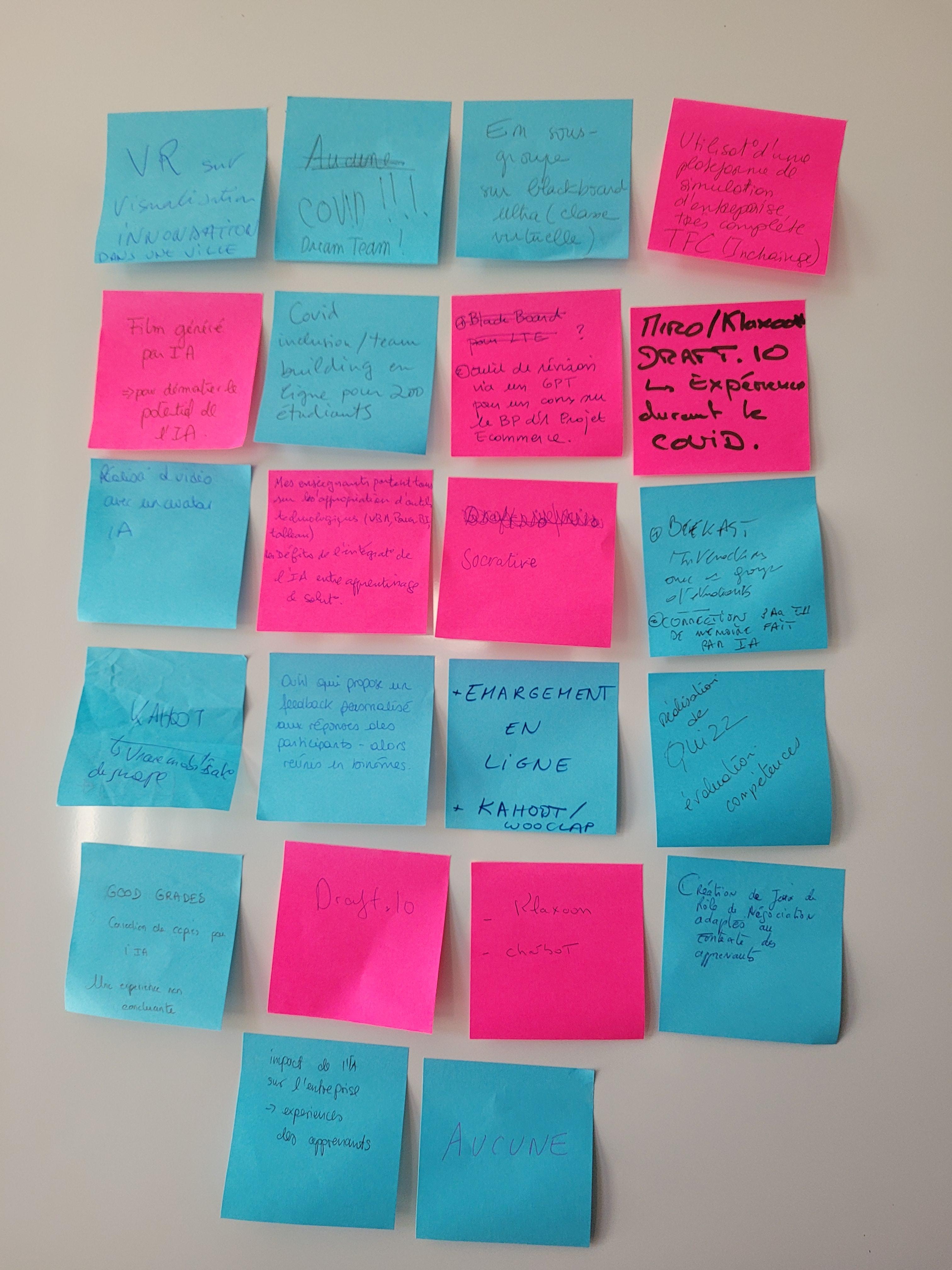
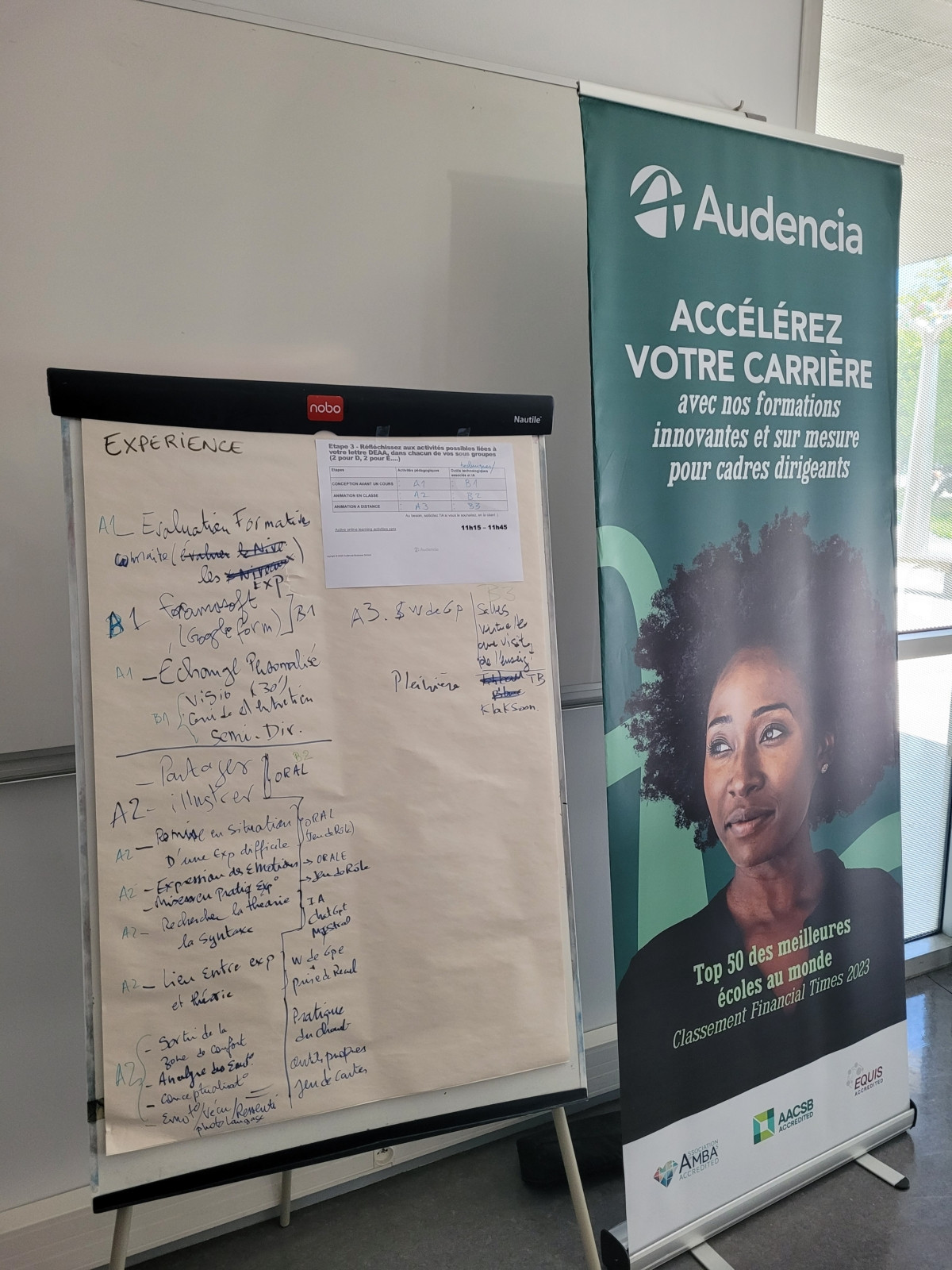
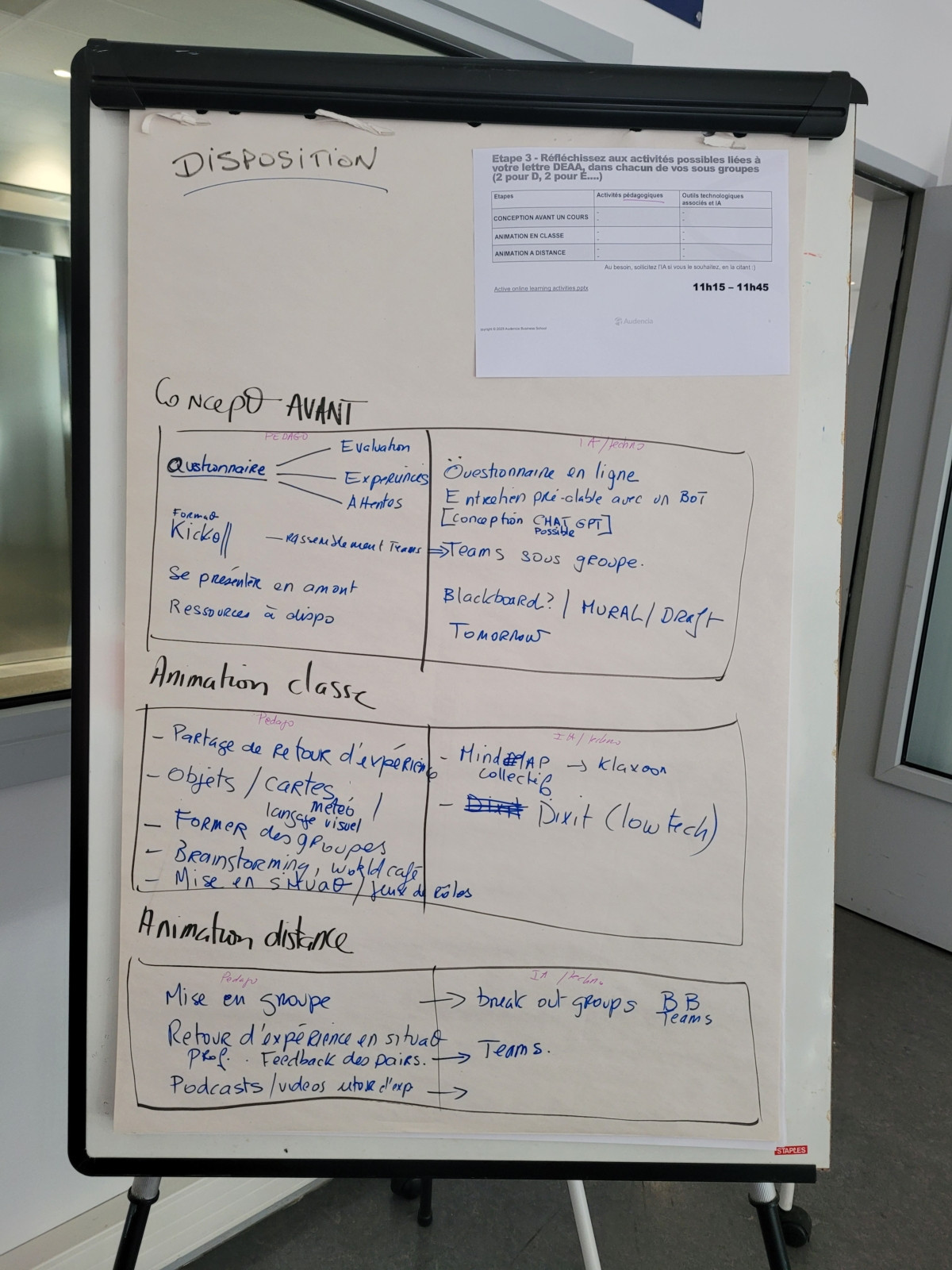
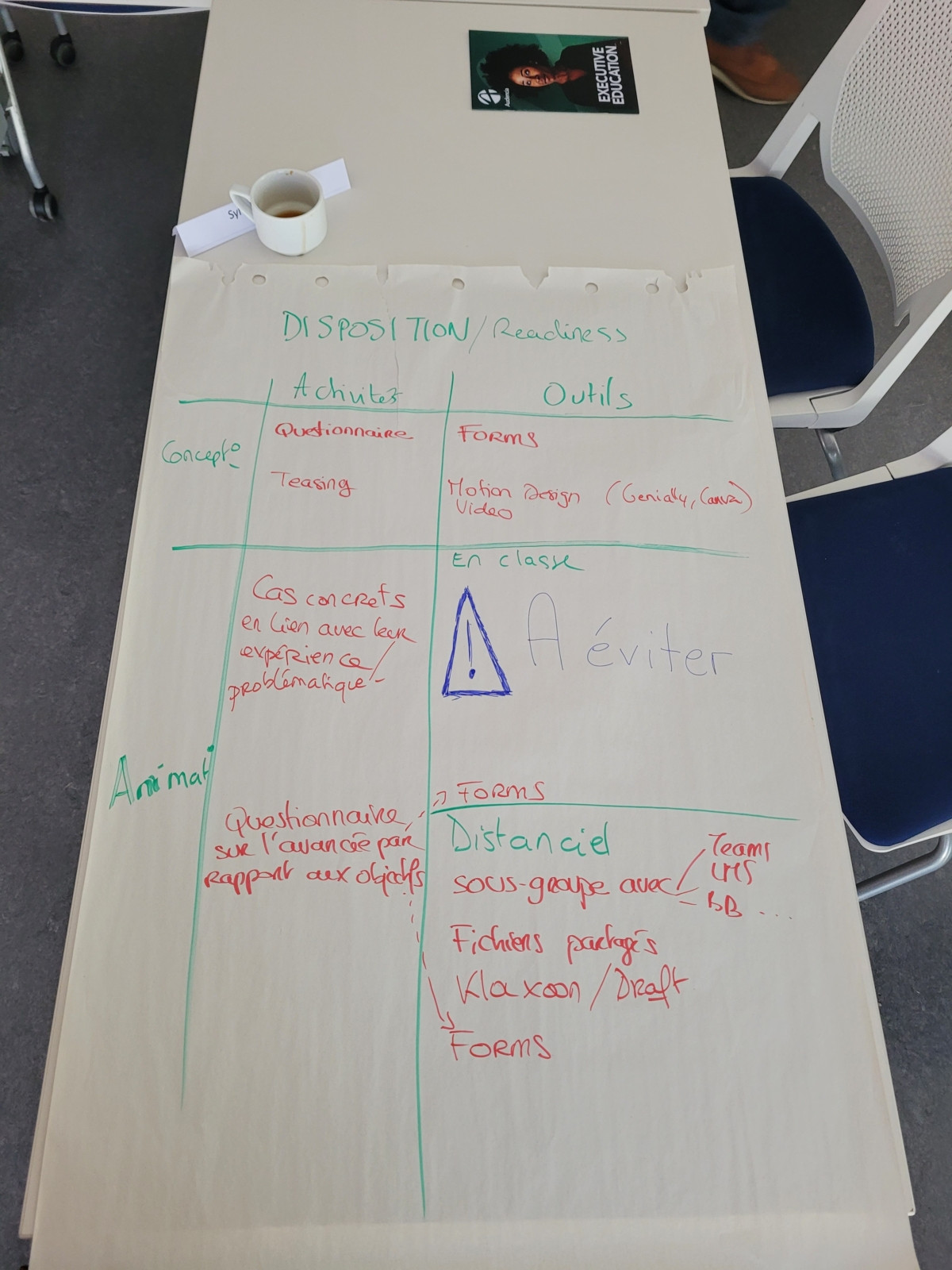
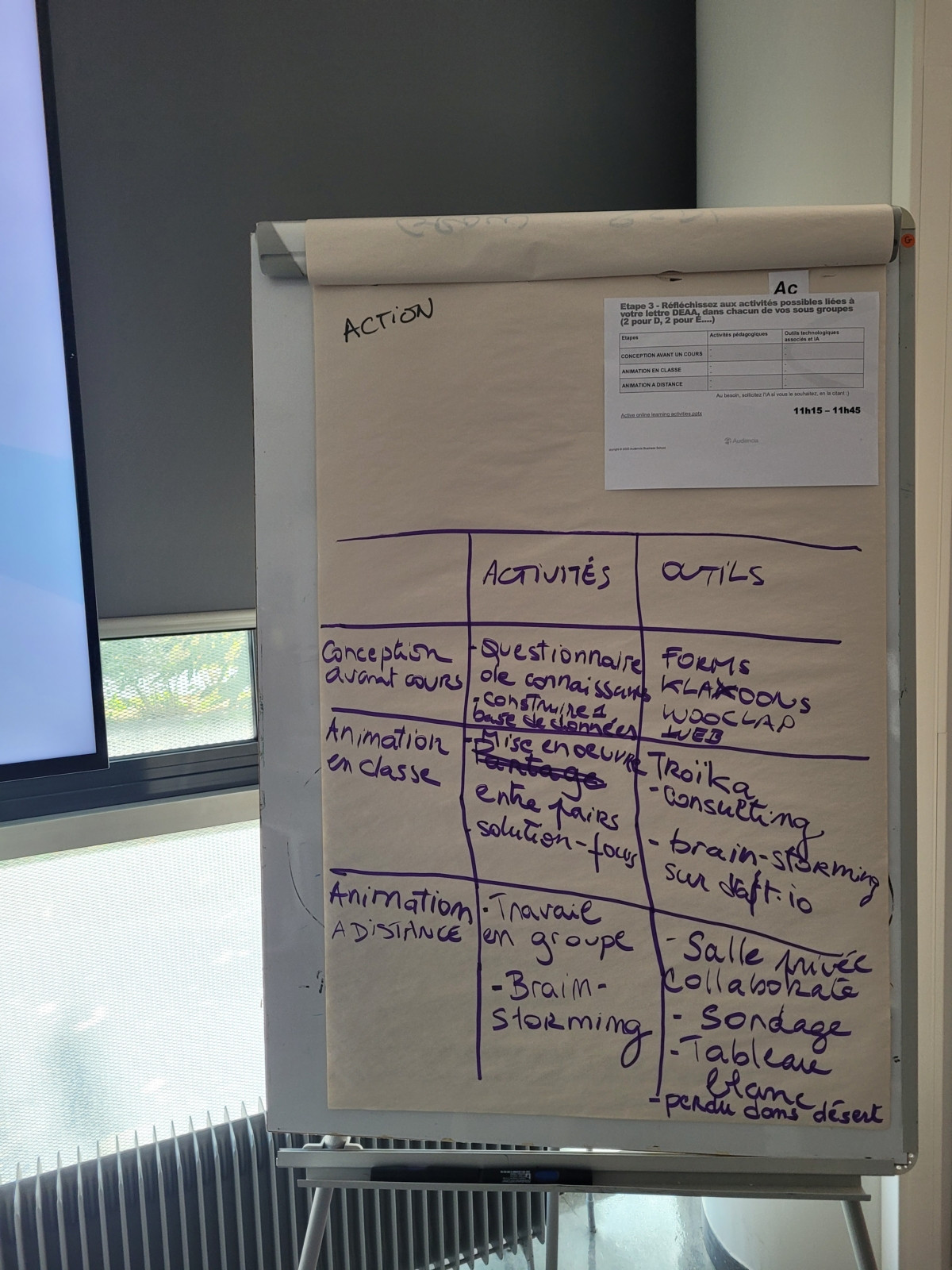
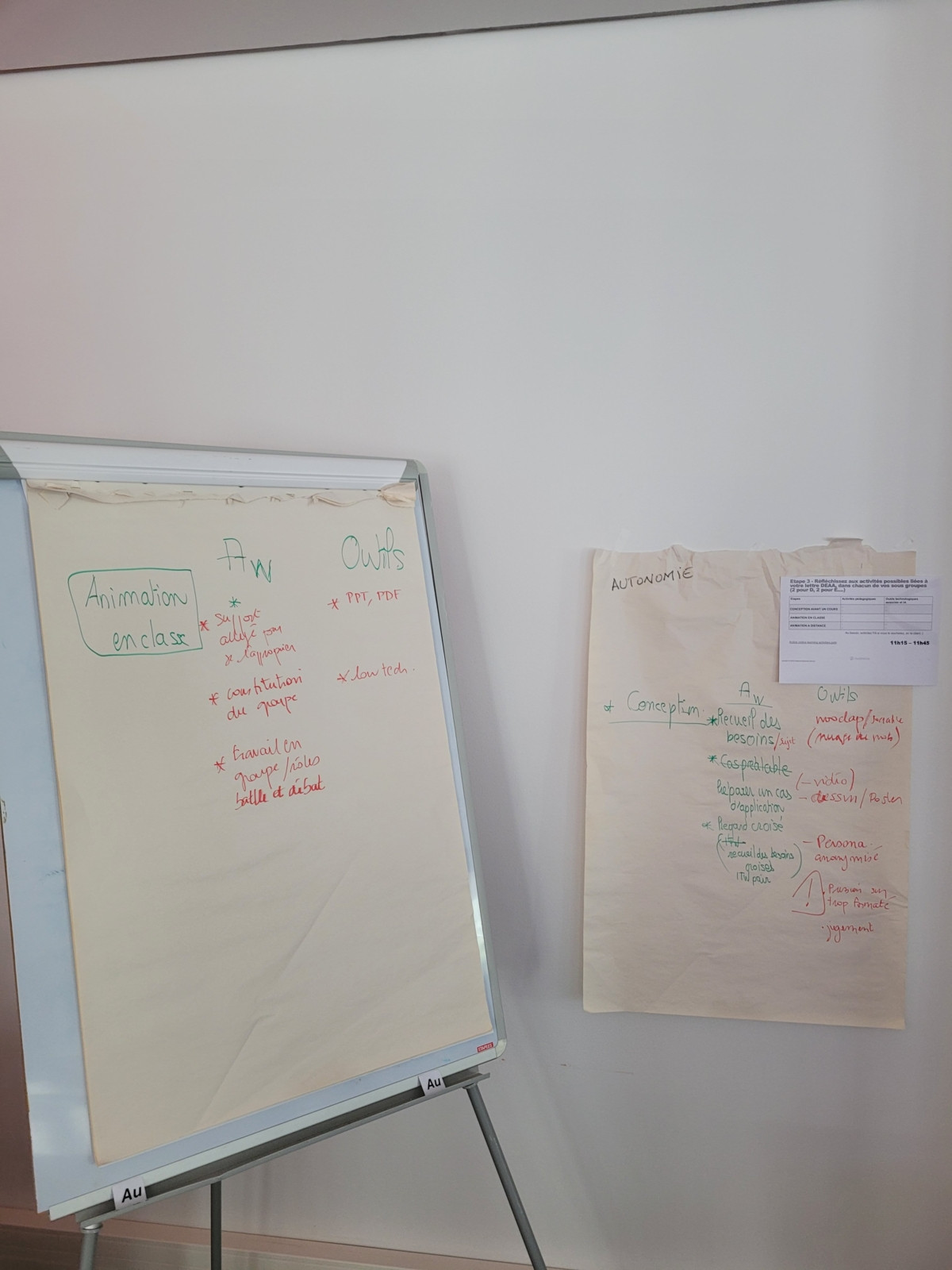
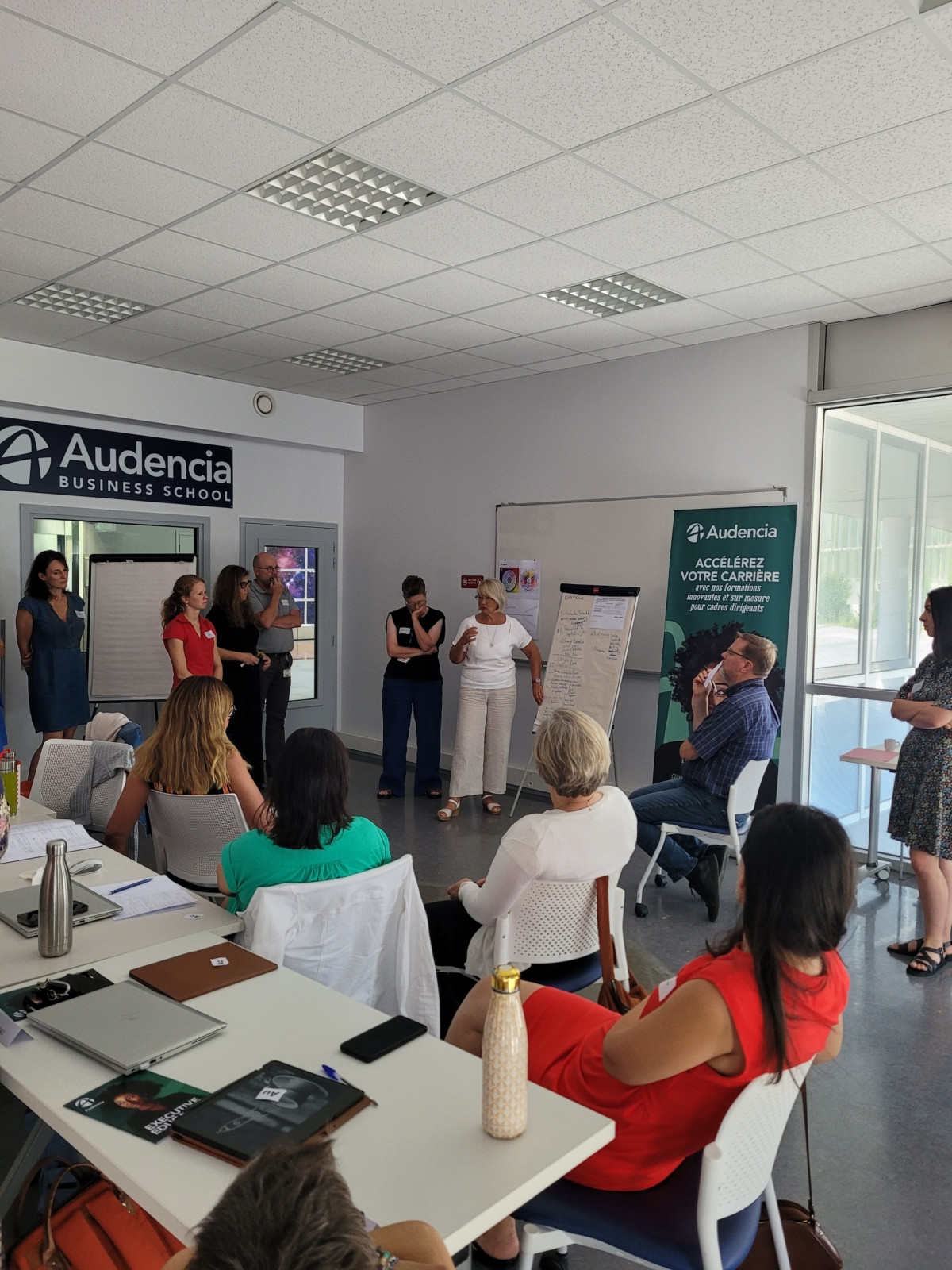
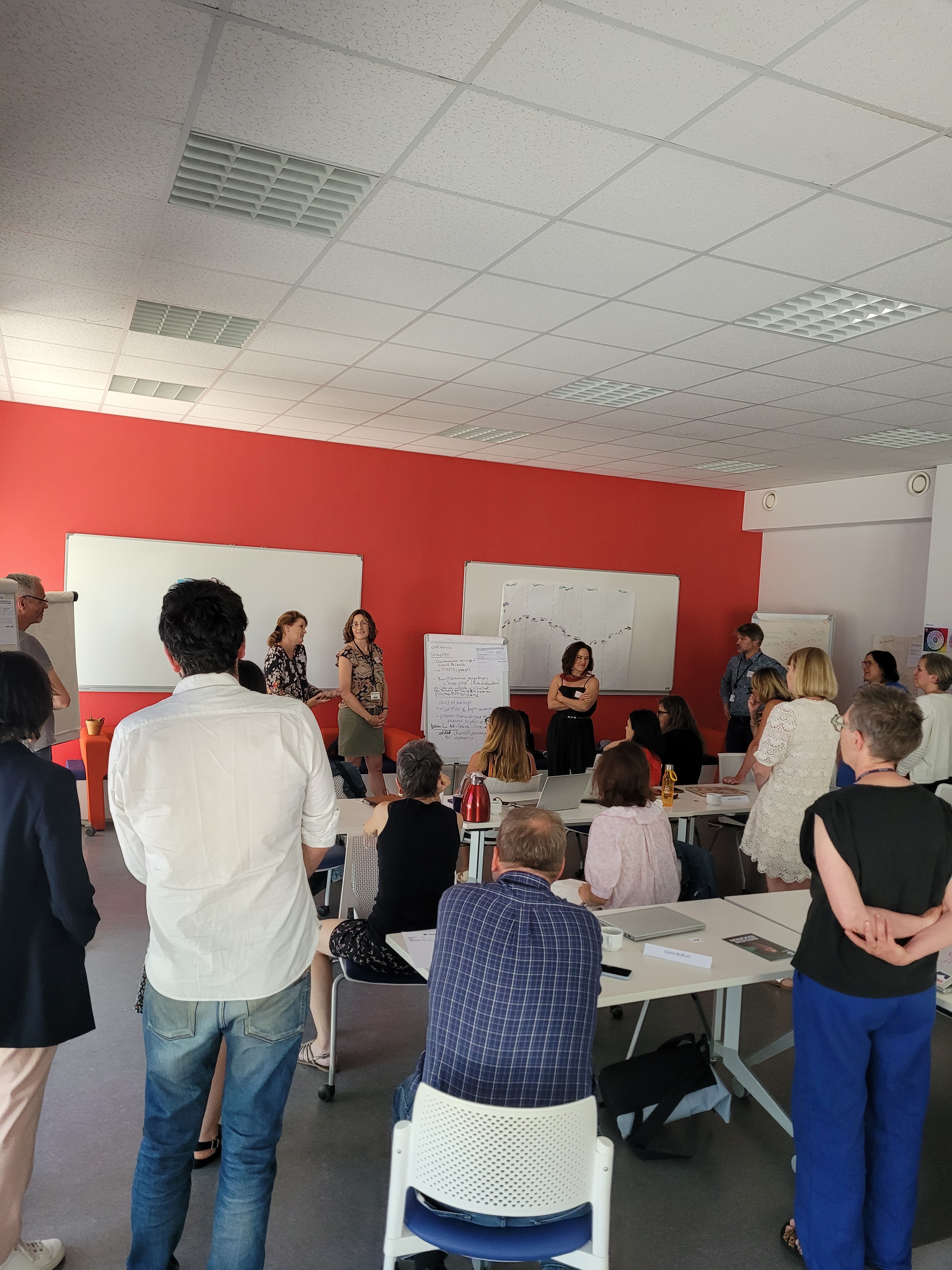
Ideas for concrete activities derived from collective intelligence
The restitution phase allowed to share a great diversity of proposals imagined by the participants. Organized according to the four dimensions of the model DEAA (Disposition, Experience, Autonomy, Action), these productions illustrated the richness of existing practices and the potential of technologies, including AI, to support adult learning.
Creating the conditions for learning: the Disposition
Several groups insisted on the importance of preparing learners even before the start of the training.
Among the proposed ideas:
-
a questionnaires upstream to identify the expectations, experiences and objectives of the participants,
-
a prior presentations of the learners in order to promote the creation of a climate of trust,
-
the provision of preparation resources or educational teasers (video, motion design, interactive content),
-
a preparatory interviews assisted by a chatbot allowing to collect needs or to customize the learning path.
During the in-person sessions, participants discussed mechanisms that promote initial engagement, such as:
-
the sharing of feedback (REX),
-
a objects or visual aids (weather maps, photolanguage) to spark discussion,
-
a scenarios or role-playing games rooted in the professional issues of learners,
-
collaborative formats like the world cafe or Brainstorming
These activities can be supported by different collaborative tools (Klaxoon, Draft, Forms, Teams, etc.), while recalling that in-person, approaches 'low-tech' can sometimes be more effective in promoting exchange.
Valuing experience: the Experience
The participants also proposed several activities aimed at mobilize the professional experience of learners, a central principle of andragogy.
Before the training, certain approaches allow for a better understanding of the profile of the participants:
-
questionnaires on the professional experiences and existing skills,
-
self-assessments or formative evaluations,
-
creation of learners' personas,
-
short individual exchanges or exploratory interviews.
During the training, many activities allow to transform these experiences into educational resources:
-
getting back in the situation or analysis of complex professional situations,
-
role plays around real issues,
-
sharing difficult or significant experiences,
-
collective analysis allowing to make the link between lived experience and theoretical concepts.
Some groups have also explored the use of AI in this dimension, for example via:
-
a chatbots simulating interlocutors or characters, allowing to test different professional postures,
-
the critical analysis of responses generated by AI to feed the pedagogical discussion.
Promote self-direction: Autonomy
Another strong focus of the proposals concerned the development of learners' autonomy in their own learning process.
Among the imagined activities:
-
a questionnaires of individual needs and objectives,
-
activities of personal diagnosis or self-positioning,
-
collaborative works in which the participants choose their own subjects or issues.
In-person, several formats promoting autonomy were discussed:
-
group work with assigned roles,
-
debates or battles of arguments,
-
educational hackathons,
-
free exploration of resources or databases.
Some ideas also integrate AI tools or content generation to support production and reflection, for example in the restitution or creation of supports.
Putting it into practice: the Action
Finally, the dimension Action gave rise to several proposals oriented towards the concrete application of learning.
Upstream of the training, some activities consist of:
-
construction of case studies inspired by real business situations,
-
collect concrete issues from the participants or their organizations,
-
prepare databases or resources that will be used during the workshops.
In training, the participants proposed several highly operational devices:
-
working in project mode,
-
collective design of solutions from real cases,
-
reverse role-playing games,
-
design by the learners of their own pedagogical scenarios,
-
peer support devices like Troïka Consulting.
Some ideas also include devices of professional jury, allowing learners to present their proposals and receive feedback from experts.
From a distance, action activities can take the form of travaux collaboratifs en sous-groupes, évaluation par les pairs ou simulations, supported by tools like Teams or Blackboard Collaborate.
A diversity of practices and tools
Beyond the activities imagined during the workshop, participants also shared many experiences already implemented in their practices:
-
immersed in virtual reality,
-
business simulations,
-
creation of videos or avatars generated by AI,
-
educational chatbots,
-
interactive platforms like Kahoot, Wooclap, Draft or Klaxoon,
-
visual collaboration tools like Miro.
These exchanges showed that educational technologies and AI are already widely present in training practices, but that their value depends above all on how they fit into a coherent educational design.
Some lessons from this experience
This workshop confirmed several important elements for adult education.
First of all, the richness of exchanges between peers: participants already have many pedagogical practices and innovations that are valuable to share.
Then, the interest of a structuring framework like the DEAA model, which allows thinking about the integration of technology not as an end but as a lever at the service of learning.
Finally, AI appears above all as a tool for exploration and pedagogical creativity, to be used critically and responsibly.
A dynamic that will continue
This first Summer University of Andragogy marks the beginning of a dynamic aimed at develop a community of practice around adult education in Audencia.
It opens the way for future sessions and new opportunities to discuss about ongoing pedagogical transformations.
For our team, it was also the opportunity to putting into practice the principles we defend on a daily basis: experimentation, collaboration, and learning by doing.


