



General context & objective
Informing apprentices of their rights and duties, as apprentices and as employees, is one of the tasks that the law entrusts to CFAs (article L6231-2 du Code du travail). At Audencia, this module has been led since 2021 by the learning supervisors for all apprentices, from the Bachelor to the Grande École Program "more than 1,400 apprentices each year".
A popular module... which was struggling to take root
The apprentices praised the quality of the information and exchanges. However, the referees observed a discrepancy: what was understood on D-Day often faded at the moment when the apprentice needed it, faced with sick leave, a delay, or a question about their contract.
The analysis of student opinions confirmed this paradox. The comments focused on density, repetitions, and lack of interaction. Above all, the apprentices were not asking for more information, but for actionable benchmarks: "What should I do if I am sick?" , "Who to contact?" "What is really expected of me as an employee?"
The subject was not the perceived quality of the module, but its anchoring.
Objective: to move from the explained rule to the professional reflex
Late 2025, Emmanuelle BOUILLON, entrusted the Learning & Teaching Development team the complete redesign of the module, in a 2-hour in-person format. Three requirements guided the project:
- a core curriculum shared by all the programs, broken down according to the level of the apprentices;
- pedagogy active and contextualized, built around real situations;
- a focus on professional posture and social skills in business.
Methodology: starting from what already exists, not from a blank page
The project took place in five stages, from the request of November 2025 to the deployment of September 2026. Each involved different stakeholders.
The L&T Designer ensures continuity from one stage to another; the referents are at the heart of co-design and deployment.
Step 1 – Frame the need
A project sheet was first co-constructed with the client: target audience, objectives, milestones, and roles of each. It was updated in the spring of 2026 to incorporate the feedback from the female representatives.
Step 2 – Diagnose from data
Before any proposal, the existing materials of each program, the syllabus and more than 400 student opinions were analyzed. This diagnosis made it possible to distinguish what was already anchored from what remained unclear.
| Theme | What the feedback show |
|---|---|
| Employee status, apprenticeship contract | The central message is getting through well. |
| Absences, delays, sick leave | Sensitive topic, still a source of uncertainty. |
| Remuneration, leave, assistance | Strong interest as soon as the impact is personal and immediate. |
| Support, "to whom to speak" | Apprentices value the school’s availability. |
| Professional posture and communication | Present, but not yet worked on as a full-fledged objective. |
The conclusion guided the rest: the in-person session was no longer intended to serve as a rereading of the legal framework, but rather to address situations. Hence a three-step logic:
- Before: I’m discovering the essentials.
- During: I deal with situations and decide what to do.
- After: I find the reliable procedures and check what I have learned.
Step 3 – Co-design with those who lead
In May 2026, the learning coordinators of each program met for a two-hour co-design workshop on a collaborative whiteboard (Draft.io). The approach was simple: the referents bring their expertise of the field and the regulatory framework, while pedagogical engineering is responsible for translation.
"I’m not going to ask you to start over from a blank page. I need your expertise: what works, what is essential, students' recurring questions." – Firas ABDELMALEK, Learning & Teaching Designer
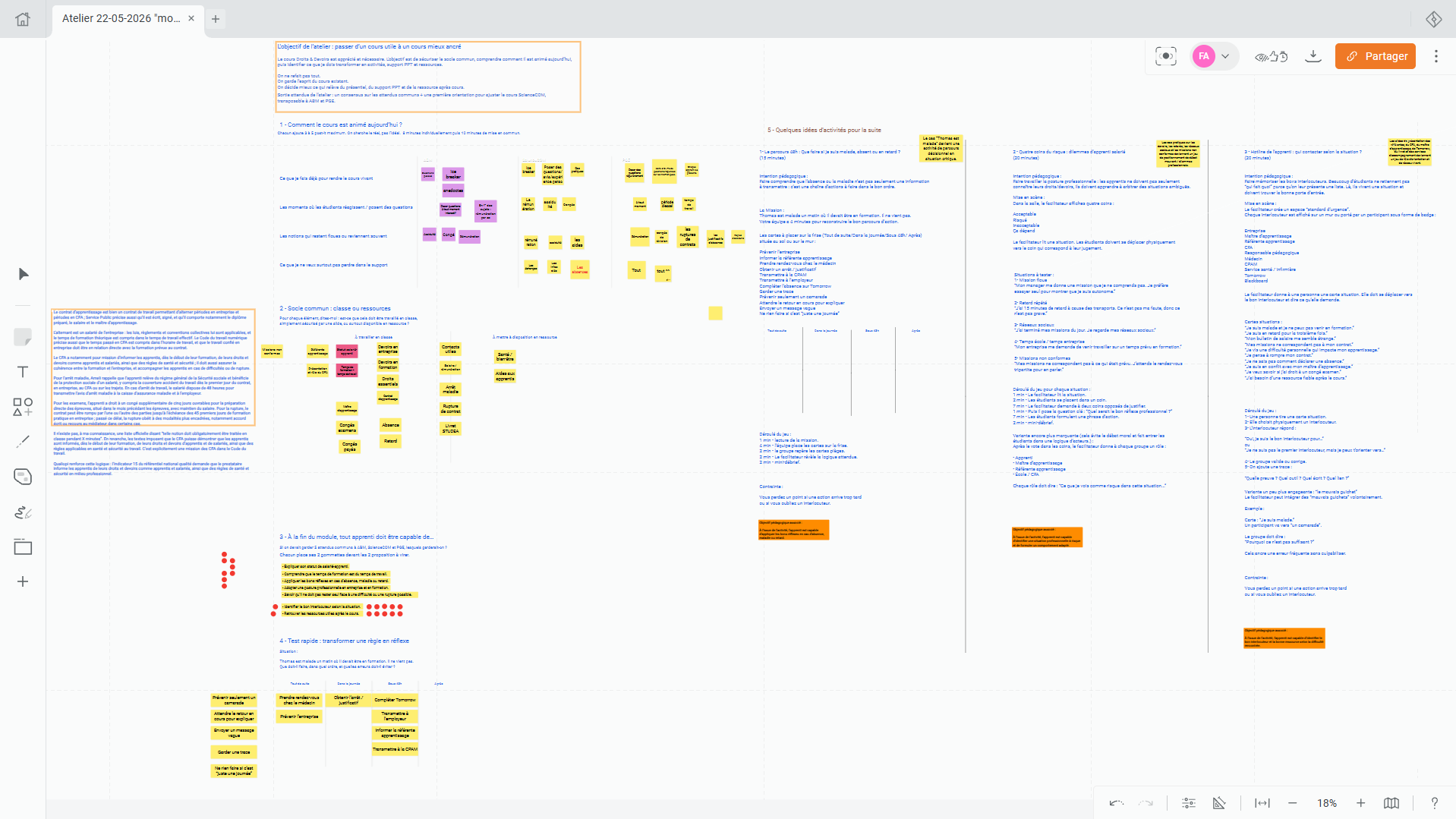
The workshop was structured in five stages:
- Describe the actual animation: when do apprentices drop out, what information is understood then forgotten.
- Sort Content: what should be studied in class because it requires a reflex or decision, and what should remain available after the course. The same subject can go in both columns: sick leave is worked on in practical cases, and then appears in a reflex record.
- Formulate the common expectations: "At the end of the module, every apprentice must be able to...". "You have to talk about leave" becomes "the apprentice knows how to distinguish paid leave, exam leave, and absence from training."
- Experiencing an activity: the referees test a format themselves, then debrief what it brings beyond a top-down explanation.
- Explore the business leads to be transposed to each program.
One principle reached a consensus and reassured everyone about respecting the framework:
"We do not remove useful information. We choose better where it is shared: in person, in the resource support, on the Blackboard LMS, or on a reflex card."
As a sign that the format pleased them, the participants asked to repeat the exercise.
Step 4 – Produce a kit ready to animate
At the end of the workshop, the old support gave way to a complete kit, designed so that each person can lead calmly:
- a presentation material: more visual and playful, structured around situations rather than rules;
- a facilitation guide: ready-to-say instructions, timing, key messages, and points of vigilance;
- a printable kit: posters, situation cards, friezes, badges and cheat sheets for apprentices.
Everything follows a common thread that the apprentices find in each activity: to prevent, justify, trace. The expected posture of the facilitator is explicit: reassuring, concrete, non-moralizing. The goal is to secure, not to scare.
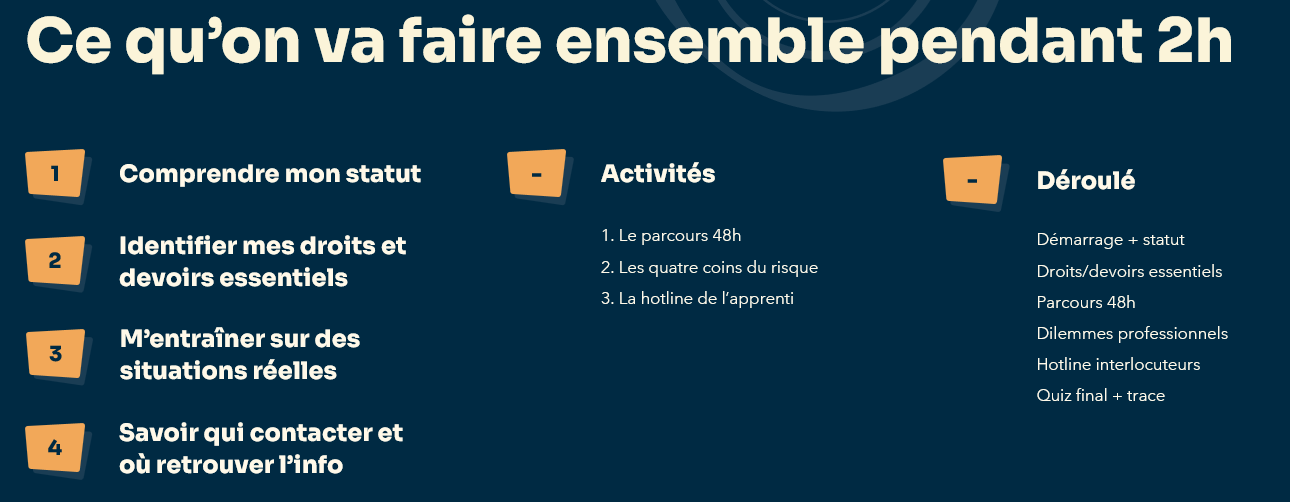
Four objectives for the apprentice
- Understanding my status as an employee in training.
- Identify my essential rights and duties.
- Practice on real situations.
- Know who to contact and where to find the information.
A 2-hour sequence
Start and status, essential rights and duties, 48-hour process, professional dilemmas, contact person hotline, then final quiz and written test with a minute paper.
Three flagship activities
"These are not games added to the course. These are three active learning formats that turn rights and duties into professional reflexes."
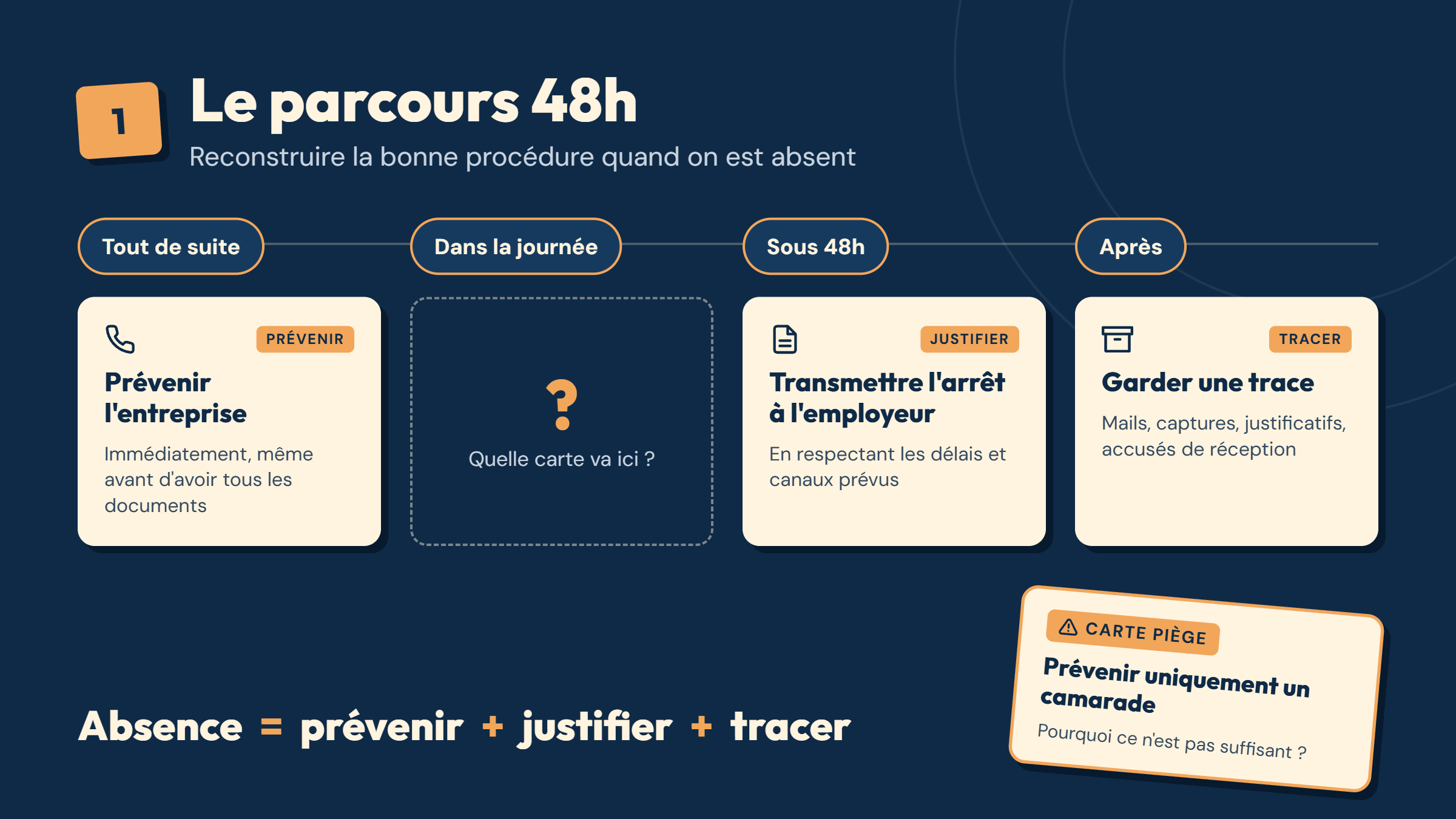
#1 The 48-hour course: follow the correct procedure
In groups, apprentices reconstruct on a frieze the steps taken by an ill apprentice one day of training: right away, during the day, within 48 hours, afterwards. "Trap" cards bring out frequent errors, such as only warning a classmate or waiting for the certificate before giving the warning. The message to remember consists of one line: absence = prevent + justify + trace.
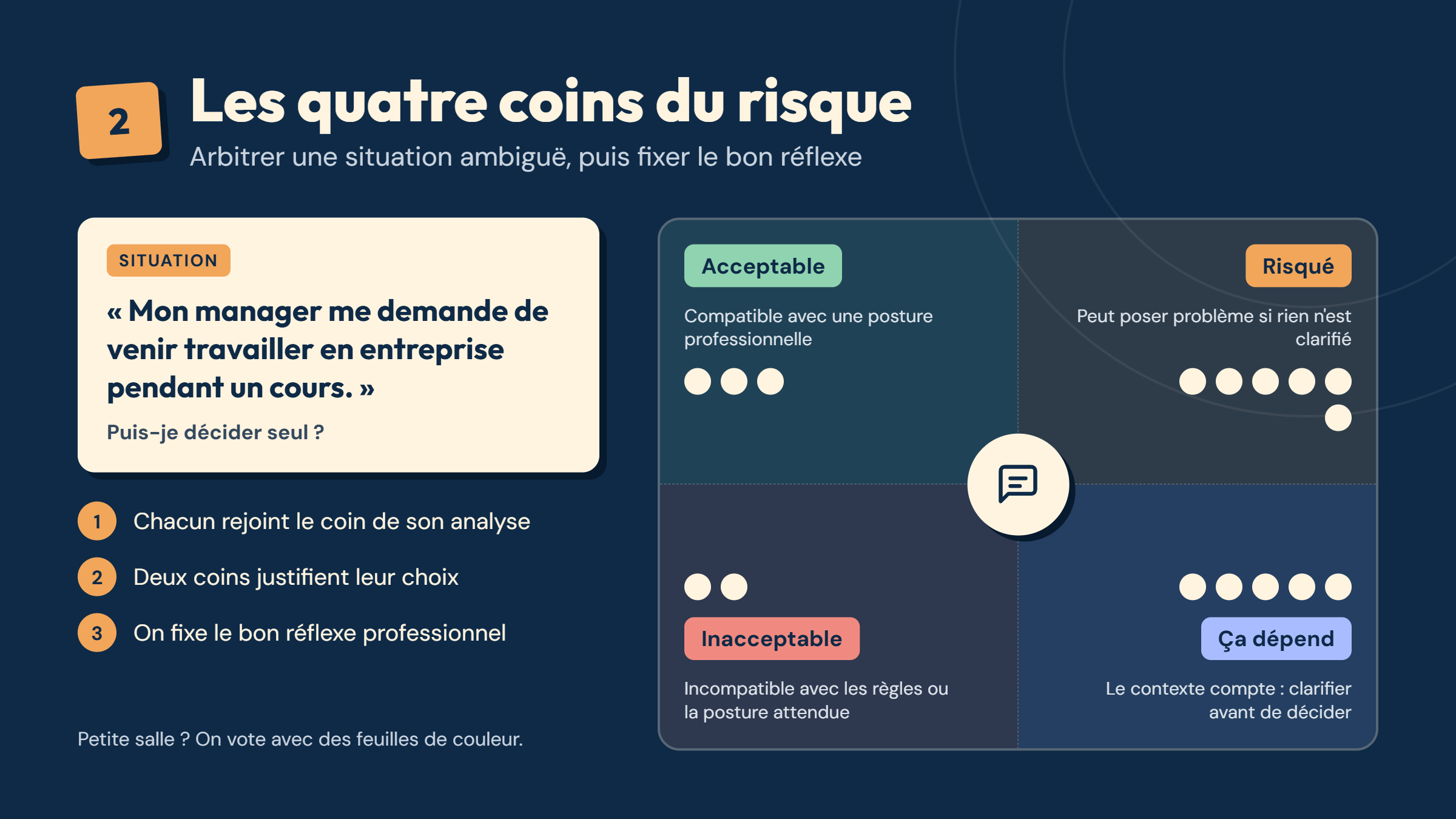
#2 The four corners of risk: arbitrating an ambiguous situation
The facilitator is reading a situation: a blurred assignment, a manager asking to come work during a class... Everyone goes to the corner that corresponds to their analysis: acceptable, risky, unacceptable or it depends. Two groups justify their choice, then the class formulates the reflex that would have secured the situation.
#3 The apprentice hotline: activating the right contact person
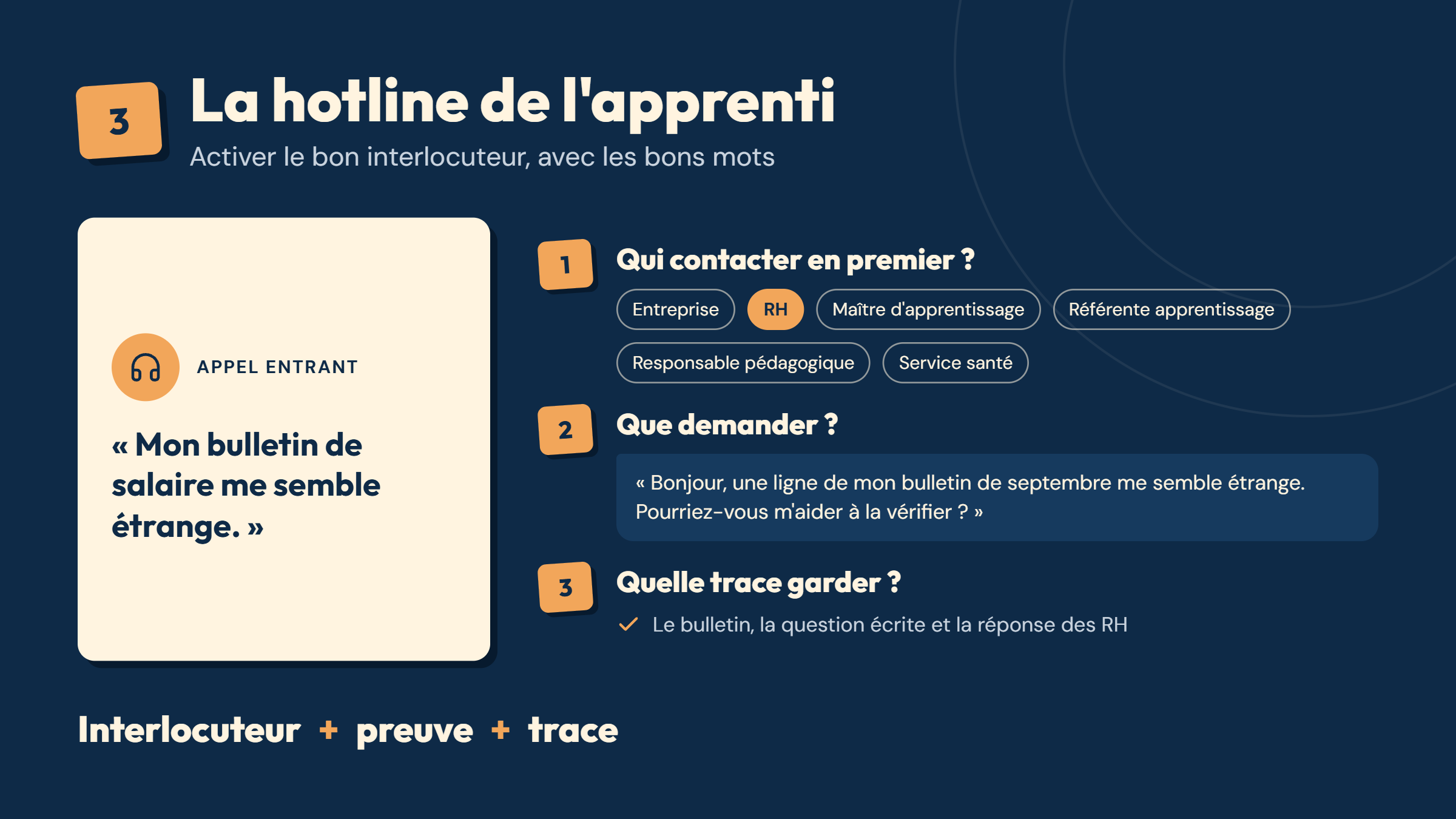
For each situation (surprising pay slip, assignments far from the contract, review leave, etc.), the group chooses the first contact person, formulates its request in one professional sentence and identifies the record to keep. The activity learns not to be alone when faced with a difficulty.
These formats are based on active and situated learning: the apprentice deals with a situation, makes a decision, confronts his reasoning, then stabilizes the rule.
Step 5 – Deployment and initial assessment
At the start of the new academic year in September 2026, the new module was taught in Bachelor’s, SciencesCom, and the Grande École Program in Apprenticeship, including its four specializations in Nantes and Paris. Initial feedback confirms that the format works, both for apprentices and teams.
A kit that each team has appropriated
Each referent adapted the kit to their constraints, which was precisely the intention: to harmonize the objectives, not the ways of animating. In the small room, apprentices vote with colored sheets rather than moving to the four corners. With groups of more than 40 apprentices, the hotline is played by freehand. In SciencesCom, the module lasted about 1h30 for groups of 30 to 38 apprentices.
What the apprentices say
| program | Participation in the questionnaire | Top Returns |
|---|---|---|
| Grande École program (24-month apprenticeship) | 293 respondents out of 465 participants | Average score of 4.39/5; 86% for grades 4 or 5; module deemed to be a training module, very clear and detailed |
| Bachelor | 71% of respondents | Module deemed clear, useful, and reassuring; interactive animation and scenarios cited as strengths |
| SciencesCom | 107 respondents | Format appreciated by all; alternation between explanations and playful practical cases |
| MS | 195 respondents | Module deemed clear, complete, useful, and well explained; Materials perceived as understandable and structured; Practical cases are appreciated when used. |
The essential concepts (rights, duties, professional posture, interlocutors) are clearly identified. Requests for clarification remain targeted: absences, examinations, breach of contract and assistance.
Testimonies of the references
"The format was appreciated by everyone. They liked the alternation between theoretical explanations and more playful and practical small cases." – , référente apprentissage SciencesCom
"A very positive assessment. The module is perceived as a trainer, very clear and detailed." – , référente apprentissage Programme Grande École
"The module is very widely appreciated by apprentices, who consider it clear, useful and reassuring. Great success!" – , référente apprentissage Bachelor
"The feedback is very positive: the module is considered clear, complete and useful, with well-structured materials and particularly appreciated practical cases." – , référente apprentissage MS®
What the Learning & Teaching Designers brings to stakeholders
This project illustrates the strength of a pair: the professional expertise of the participants on one side, and pedagogical engineering on the other. The supervisors know the framework and the apprentices; the Learning & Teaching Designer transforms this knowledge into a learning experience.
Specifically, an L&T Designer can provide you with:
- A data-driven diagnosis: : cross-reference materials, syllabuses, and student opinions to name the real problem before looking for solutions.
- A facilitation that saves time: you bring your expertise, the pedagogical translation is supported.
- Reasoned design choices: Each activity meets a specific objective (follow a procedure, arbitrate, find one’s way).
- Ready-to-use tools: instructions, timing, vigilance, printable material, pre-session checklist.
- A common framework that leaves the hand harmonized objectives, an animation that everyone adapts to their room and their group.
" My role is not to tell the speakers how to animate, but to transform what they know into situations where apprentices train. " – Firas ABDELMALEK, Learning & Teaching Designer, pôle L&T Development
Do you have a course or module that needs to be revitalized? Fill out the pedagogical engineering need form or write to us at pedagogy@audencia.com.
And now? Avenues for continuous improvement
This first edition lays a solid foundation; the feedback already opens the next version.
- Win again in concision. Some apprentices report redundancies and a somewhat long duration, especially those who have already had a first learning experience. A positioning time at the beginning of the session could help adjust the pace.
- Measure the cold anchoring. Satisfaction on the spot is there; the real indicator remains what apprentices know how to do a few weeks later. A short test, before and then after the module, is being studied.
- Extend online. An entry path on Blackboard and "What to do if...?" cards would allow you to find the information at the right time.
- Feed the resources with minute papers. The points that remained unclear (absences, exams, breakups, aids) indicate which forms should be prioritized for improvement.
- Continue co-design. The contact persons requested a new time for discussion: the opportunity to share each other’s adaptations and to enrich the kit.
"You don’t need to remember everything by heart. But you need to know how to respond, who to contact, and where to find reliable information."
Project team and thanks
This module is the result of collective work. Thank you to everyone for their expertise, availability, and openness to change.
And of course, thank you to the apprentices whose feedback fed each step.


