




- Home
- >
- FACILITATING AND EVALUATING STUDENTS
- >
- Inspiring events
- >
- AI4ALL – Donner les bons réflexes aux étudiants qui entrent...
General context & objective
Since its emergence just over two years ago, AI has gone mainstream among students, starting as early as high school. We’ve seen it firsthand in our AI awareness workshops for Bachelor students with a striking jump in adoption between March 2024 and March 2025. Adoption is now widespread and spans a wide range of tasks, as confirmed by the study from the French Ministry of Higher Education and Research in june 2025. But educators’ observations tell a more nuanced story: massive use, yes. Effective and thoughtful use? Far from it.
Institutional objective: to provide a common base for all first-time students
"Any student who joins Audencia from the start of the 2025 academic year will follow an AI workshop day. It is about training them in prompting, raising their awareness of intellectual property and ethics, and teaching them to choose the right AI... and to use it well." – Sébastien Tran, Dean (Directeur General) of Audencia
In June 2025, the direction of the programs led by Denis Boissin has therefore decided to frame and guide the use of AI among incoming students, over 1,200 of them, through an 8-hour module delivered from the very start of the academic year. This module targets Bachelor, SciencesCom, and Grande École Programme students first, across both French- and English-speaking cohorts. The goal: to build a solid AI literacy from day one, ensure students understand its limits and risks, and instill the right reflexes from the outset.
Project development and educational team
Project led by Sylvie Chancelier, a working group was then formed, internally first, with the Learning & Teaching Development Team, a volunteer teacher (Dan Evans), and the Knowledge Hub.
It had been several months since the subject had been anticipated, and the reflection was quite clear on the objectives. Contributed to this rapid operationalization as much the experiments of the AI Lab that our constant monitoring and the AI Bachelor workshop mentioned above. Thus, an 8-hour program was very quickly decided around the following objectives:
#1 Understanding the fundamentals of AI and generative AI
- Identify and define the different forms of artificial intelligence.
- Understanding the functioning of generative AIs.
- Master the 10 classic use cases of generalized generative AI.
- Knowing how to distinguish generative AI tools and uses adapted to Audencia students.
#2 Practicing the art of prompting: interacting effectively with an AI
- Master the fundamentals of a good prompt, applying a clear and structured method to obtain relevant answers.
- Develop effective dialogue reflexes with an AI, by understanding the concepts of iteration, training data, and bias.
- Experiment with different prompting strategies, by testing and comparing several approaches.
- Explore professional use cases and AI conversational agents, discovering how LLMs and RAG fit into concrete tools according to the professions.
#3 Developing a critical mindset in the face of AI
- Understand the risks associated with non-critical use of AI (cognitive discharge...).
- Identify cognitive biases, hallucinations and validity limits of responses generated by generative AI.
- Position oneself against the risks related to the use of AI.
- Understand the ecological impacts of generative AI and integrate them into its uses.
#4 Using AI responsibly in one’s student life and future professional
- Knowing how to mobilize generative AI in one’s learning without depending on it.
- Adopt an ethical posture of use, singularity and authenticity in his writings and creations.
- Understand the regulatory, ethical and professional issues related to the use of AI, particularly in terms of confidentiality, transparency and compliance with the frameworks in force (AI charter and Audencia IA positioning, AI ACT / GDPR).
- Develop one’s reflexive capacity and autonomous reasoning.
With the validation of the Programs Department, the project team (composed of its pilot and the L&T Development team) has retained the proposal forOBEA – previously intervened to develop the Catal'IA online training for AUDENCIA collaborators – to support them in this development. The firm was thus able to quickly adapt the content and tone to suit the interests of the students.
A training program based on a hybrid format and active pedagogy
The first two modules on the discovery of AI and prompting were developed in a self-supporting online format, with a set of interactive activities to keep the students' attention. These modules allowed to give the basics while preparing the last two modules done in person.
Having trainers, from the company, who challenge students live on their critical thinking, on the relevance of using IAg or not, on how to integrate it into their learning was an essential part of the chosen pedagogy. Many small group activities have been developed, close to their concerns.
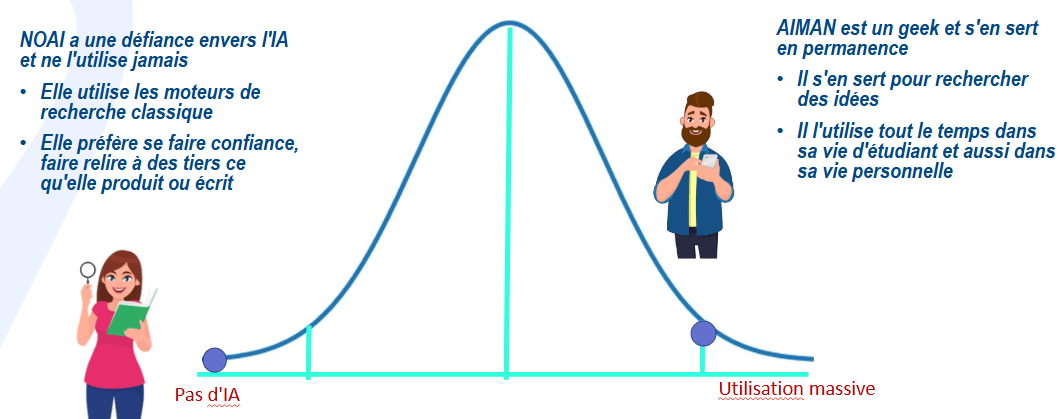
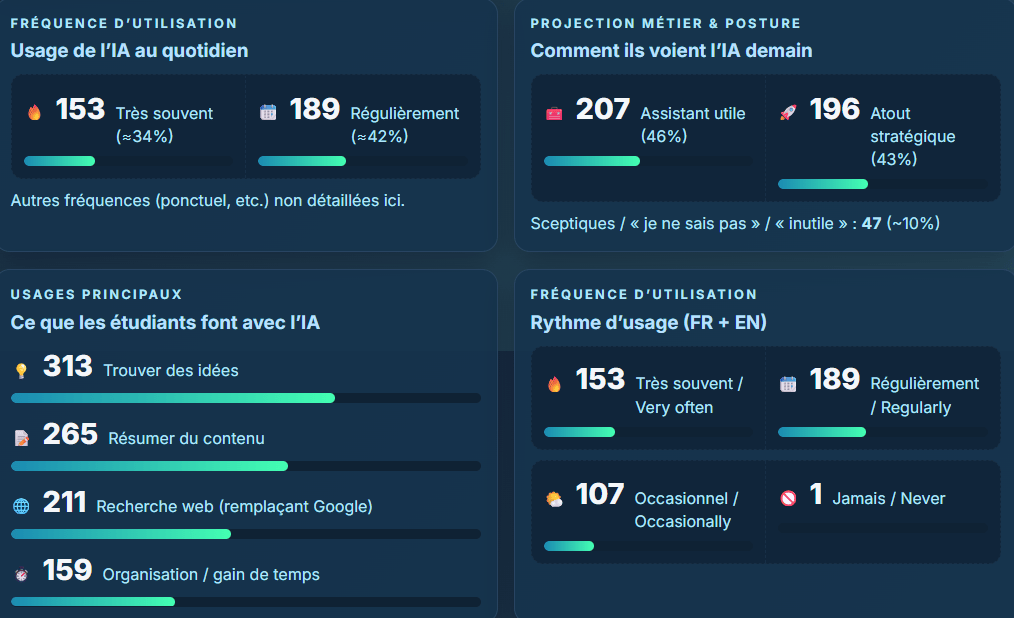
Overall assessment of the experimentation on the Bachelor cohort
It was interesting to see at the beginning of training, in the "profiler" developed by OBEA, where their uses were located
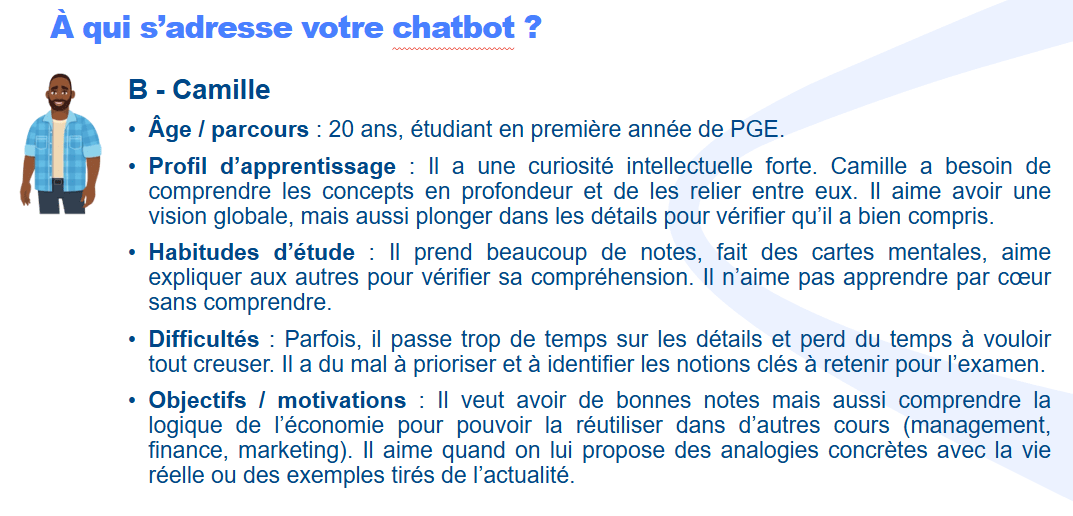
The students generally appreciated the course in its first version: they appreciated the activities, asking for even more (chatbots...). One of them was particularly appreciated, the construction of a chatbot allowing to help fictional characters with learning difficulties and/or marked learning preferences.
Also appreciated were the examples given by the trainers around the transformation that the IAg brings to the company. They were able to provide a very concrete form of field testimony. Moreover, students expect a lot of sharing with professionals around these transformation topics.
These results, to be cross-checked with those of the PGE cohort at the beginning of 2026, should be anchored throughout their schooling in their learning experience, guided by their teachers, to allow them to put the IAg back in its place: a useful assistant, but to be constantly monitored!
Testimonials and feedback from the facilitators
The feedback from the facilitators converges on a very positive observation: the students showed themselves very interested and have particularly appreciated the concrete and practical approach of the device. Several speakers even describe a real trigger during the session : over the activities, students become clearly more aware of the risks, the limits and the need to verify the sources.
In mirror, the expressed improvement tracks are consistent with student feedback: more time to practice (prompting, techniques, chatbots), more activities and of playful/collaborative formats, and the desire to go further on some advanced uses (e.g. AI agents) while strengthening the links with the professional world (business case, exchanges on business practices, follow-up sessions to stay updated).
These first quantitative and qualitative results are also reflected in the numerous testimonies shared by the speakers and the teaching team. They illustrate the commitment of students, the richness of exchanges and the diversity of pedagogical approaches implemented in AI4ALL.
To go further, discover these feedback:


